All Pakistan Educational Board Results Portal

AJK Summer Camp Guidelines 2026 for Schools During Summer Vacations

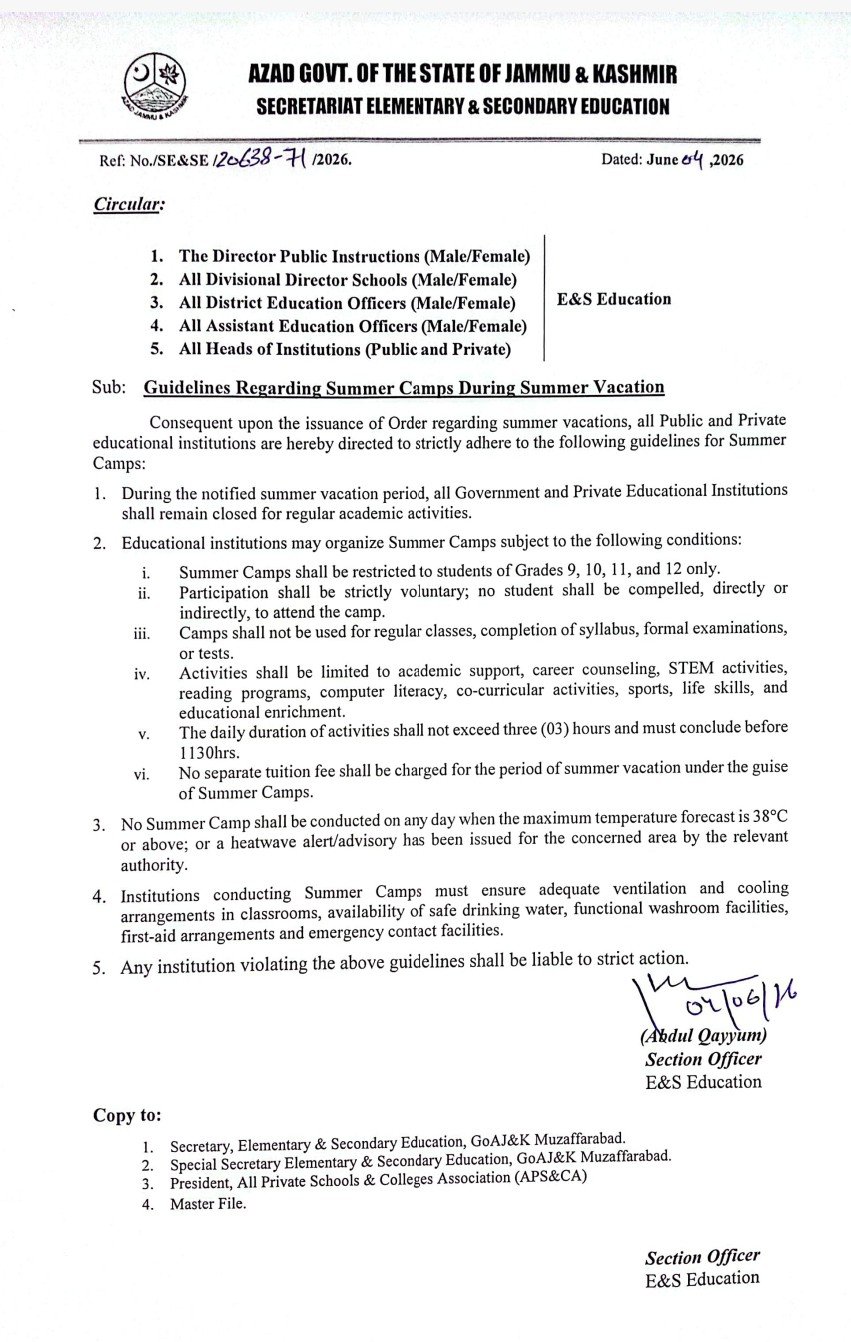
AJK’s Education Department has released official Summer Camp Guidelines 2026 for public and private educational institutions. Summer camps are limited to Grades 9 to 12, must remain voluntary, and cannot be used for regular classes or examinations. Strict safety measures and weather restrictions apply, including cancellation during extreme heat conditions.
As temperatures continue to rise across South Asia in 2026, education authorities are facing a difficult challenge: balancing student learning opportunities with health and safety concerns.
The Elementary and Secondary Education Department of Azad Jammu and Kashmir (AJK) has now issued a formal circular outlining how schools can conduct summer camps during the official summer vacation period.
The new policy introduces clear limits on participation, camp duration, academic activities, and weather-related safety requirements. The move reflects a broader trend among education systems worldwide that are prioritizing student wellbeing while still offering enrichment opportunities outside the traditional classroom calendar.
What Does the AJK Summer Camp Circular Say?
According to the official circular issued on June 4, 2026, all government and private educational institutions must remain closed for regular academic activities during the notified summer vacation period.
However, schools are permitted to organize summer camps under specific conditions.
Key Requirements
Schools may conduct summer camps only if they comply with the following rules:
- Participation must be completely voluntary.
- Camps are restricted to students in Grades 9, 10, 11, and 12.
- No student can be forced to attend.
- Camps cannot be used for syllabus completion.
- Formal examinations and tests are prohibited.
- No separate tuition fees may be charged during summer vacation camps.
Approved Activities for Summer Camps
The circular encourages educational enrichment rather than traditional classroom instruction.
Schools Can Organize
- Academic support sessions
- Career counseling programs
- STEM learning activities
- Reading initiatives
- Computer literacy training
- Sports and fitness activities
- Co-curricular programs
- Life skills development workshops
This approach aligns with modern educational models that emphasize practical learning and skill development over exam-focused teaching.
Safety Measures Take Priority
One of the most important aspects of the policy is its focus on student safety.
Institutions conducting summer camps must provide:
- Proper classroom ventilation
- Cooling arrangements
- Safe drinking water
- Functional washrooms
- First-aid facilities
- Emergency contact systems
Heatwave Restrictions
The Education Department has imposed a strict weather-related condition.
Summer camps cannot be conducted when:
- Forecast temperatures reach 38°C or higher
- A heatwave advisory is issued by relevant authorities
This requirement reflects growing awareness of climate-related risks affecting students and school operations.
Summer Camp Rules Comparison
| Area | Allowed | Not Allowed |
|---|---|---|
| Student Participation | Voluntary attendance | Forced attendance |
| Eligible Grades | 9 to 12 | Lower grades |
| Academic Support | Yes | Regular classroom teaching |
| STEM Activities | Yes | Syllabus completion |
| Career Counseling | Yes | Formal examinations |
| Sports & Life Skills | Yes | Mandatory testing |
| Fees | No additional charges | Separate tuition fees |
| Camp Duration | Maximum 3 hours daily | Extended sessions |
Why This Policy Matters in 2026
Education systems globally are adapting to changing climate conditions and student wellbeing concerns.
The AJK guidelines demonstrate three important priorities:
Student Safety First
Heat-related illnesses among students remain a growing concern during summer months. Limiting camp hours and enforcing temperature thresholds reduces health risks.
Flexible Learning Opportunities
Instead of focusing on exams, schools are encouraged to provide enrichment experiences that build practical skills.
Better Regulatory Oversight
The circular creates a standardized framework for both public and private institutions, reducing confusion and ensuring consistent implementation.
The Human Root
Education policies are ultimately about people, not paperwork.
For students, these guidelines create opportunities to explore STEM subjects, career planning, digital literacy, and life skills without the pressure of examinations.
For teachers, summer camps provide a chance to experiment with interactive learning formats that are often difficult to implement during the regular academic year.
From an ethical perspective, the emphasis on voluntary participation is significant. It protects students from indirect pressure and helps ensure that summer vacation remains a period of rest and recovery.
The inclusion of heat-related restrictions also highlights a broader reality: climate adaptation is becoming an increasingly important part of education policy worldwide.
The Verdict
The AJK Summer Camp Guidelines 2026 strike a practical balance between educational enrichment and student safety.
By restricting camps to voluntary participation, limiting daily duration, prohibiting formal academic instruction, and enforcing heat-related safety measures, the Education Department has established a clear framework that schools can follow responsibly.
As climate challenges continue to influence educational planning, policies like these may become a model for other regions seeking to combine learning opportunities with stronger student protection measures.
